
MISCONCEPTIONS ABOUT HOME STAGING
Myth #1 – HOME STAGING IS TOO EXPENSIVE
Home staging equals more equity. It is very cost-effective. A good Home Stager will work with you to come up with a budget-friendly plan.
At Pemberley Lane we offer a one-hour walkthrough for $125 or a two-hour consultation with an in-depth written report for $225 that will give the do-it-yourself person a room by room plan on how to make the best first impression.
No matter what the option good Home Stagers will emphasize low-cost recommendations and cost-effective solutions that will contribute to an excellent return on investment.
Often just the re-location of furniture and some well-chosen accessories can make all the difference in getting the price you feel you deserve.
Myth #2 – HOMES WITHOUT HOME STAGING SELL QUICKLY
Selling a home quickly involves the combination of having the right price for the area, marketing the space properly and preparing the home for purchase.
Most homes will eventually sell without home staging but why put yourself thru days and days or weeks and weeks of keeping your house tidy waiting for prospective buyers to show up.
MYTH #3 – IT IS NOT WORTH SPENDING MONEY ON SOMETHING THE BUYER CAN EASILY CHANGE OR FIX THEMSELVES
Potential buyers will deduct money from their offer based on items they feel they will need to fix. For instance, it may cost the seller $100 to $200 to buy paint to freshen up a room or two and maybe this will take them a weekend as a do-it-yourself project. However, a potential buyer could deduct $1,000 or more from their offer because they don’t like painting or do not have the time or inclination to do it and feel they have to hire a professional to get the work done.
Buyers will exaggerate repair costs in their mind and then provide a lower offer, if they make an offer at all. Therefore, leaving the buyer to tackle some easily camouflaged or easily fixed problems is not a good idea.
MYTH #4 – SMALLER HOMES ARE NOT WORTH STAGING
Smaller homes have lots to gain with staging. You can use the opportunity to emphasize good points of the home – like views and storage space. You can also illustrate more coherently the size and purpose of each room.
MYTH #5 – CONVERTING A BEDROOM INTO A HOME GYM IS A GOOD IDEA
Bedrooms are one of the most valuable commodities of any home listing. Having a home gym set up in a bedroom will prompt buyers to wonder why that is. Buyers may question whether the room is large enough for a proper-sized bed and dresser.
MYTH #6 – A MAJOR REMODEL OF A KITCHEN OR BATHROOM IS SURE TO BOOST A HOUSE SALE PRICE ENOUGH TO BE WORTH THE COST
Not necessarily. Ask your Agent for their opinion before you invest large amounts of money. They can tell you what is going on in your area. They can let you know what homes similar to yours are selling for and what level of finish these homes have. You need to know how much work has been done on other houses for sale in your area and what is the quality of the work. Then you can decide if you should undertake a more costly remodeling project before selling.
For example: If your cupboard doors are worn or just an unattractive colour maybe it would be a good idea to paint them instead of replacing them at a much higher cost. You can freshen up a room immensely by doing this.
To your success,
Linda Gardner
Pemberley Lane Design
905-466-6321
www.pemberleylanedesign.com

CREATING A GALLERY WALL
Displaying a collage of items on a wall in your home or office can give people a sense of who you are. A collage can add warmth and comfort to any room. However, hanging a gallery wall can be daunting.
When you have a number of items you want to display you must plan how you want them positioned to ensure a cohesive arrangement. This will also help you avoid creating unnecessary holes in the wall. Try to choose those items that have some commonality between them. This could be as broad as sporting event shots, portraits, pictures or paintings of places you have enjoyed visiting, etc. If you have different themes you want to show I suggest you display them in like frames (similar width and colour). This will easily form a bond between the items.
The first thing you need to decide is what area of the wall you want to cover. Then gather those items you want to put on display. Next, buy butcher paper that you can roll out in strips to the size you want to cover on the wall and enough pushpins (like the ones you use on bulletin boards) for each item you want to hang. Have a level handy, some string, scotch tape and enough picture hangers for the approximate weight of each item.
Follow these steps:
- Lay out the butcher paper on the floor to the size you want to cover on the wall.
- Position the largest items on the paper first and then build around them. Try to leave a gap between each item of no more than two inches.
- Working on the floor allows you the creativity to move items around and come up with an arrangement that will make you happy.
- When you have finished arranging the items trace each one with a pencil. Remove the items and cut out the shapes of each one.
- If you want to put the items in rows. Mark how far down from the ceiling you want to start the first row. Then stretch a piece of string between two push pins on the wall so that you have a straight line to follow and do the same thing for each additional row.
- Put the butcher paper cutouts on the wall in the order you have arranged them on the floor. Secure each one with tape on the corners. If something doesn’t look quite right it is easy to peel the paper off and rearrange it.
- When you are happy with the design, install the picture hangers for each frame overtop of the cutouts and then remove each cutout as you replace it with the actual item.
To your success,
Linda Gardner
Pemberley Lane Design
905-466-6321
www.pemberleylanedesign.com
FENG SHUI
Clutter Clearing Tip
Feng Shui is a way to create positive energy in your life. It can be a subtle way of drawing people into a space so that they feel comfortable and welcome.Clutter clearing contributes to good Feng Shui.
Clutter is an obstacle to the flow of good energy. When you clear the clutter you not only enable good things to happen in your life, it frees your mind to concentrate on other more important things.
Clearing clutter is not about being fanatically perfect. It is just a way to clear out the stuff you really don’t use, don’t need or don’t love and make way for new things or new experiences for the person you have evolved into today.
Start with one small project – one drawer or one cupboard. Stick to a reasonable schedule for yourself until you have uncluttered every room in your home. That way it will not be overwhelming.
When you hold on to clutter you are holding on to the past and that can keep you stuck and not able to move forward in life in a happy way.
If you need to giveaway or sell a piece of furniture that you are particularly fond of but have no room to accommodate, take a picture of it and put it in a nice frame so that you will have a good feeling whenever you look at it.
Do not keep things out of fear or obligation. This creates stagnant energy.
If you have an aggressive deadline to meet, enlist the help of a friend or professional to assist you. Four hands are always better than two.
HOARDING
More Common Than You Think
A Hoarder can be described as anyone who feels the need to collect and keep anything and everything because they do not know how to throw out things or give things away. They allow stuff to take over their life.
Very often we think that people who hoard stuff are just untidy or too lazy to throw out items that appear to the observer to be useless and unnecessary. However, according to Michael Tompkins, PhD, a psychologist and co-author of “Digging Out; Helping Your Loved One Manage Clutter, Hoarding and Compulsive Acquiring”, he believes that hoarders have an intensive emotional attachment to objects that others see as trivial or even trash and they would feel a sense of loss if they had to throw any items away.
Hoarders believe that many items have an intrinsic value, like others might value artwork, etc. and they think that an item might be useful someday.
When you are faced with someone who is a hoarder it is important to understand that they probably developed this tendency because of health issues, such as depression, anxiety disorders or attention deficit disorder, etc.
If you have been in a position where you have tried to address a hoarding situation with a person who is a hoarder, the discussion may not have ended well. A hoarder may feel you have overstepped your boundaries and may shut you down quickly because they clearly feel they do not have such a problem.
As you can probably guess no amount of shaming them or yelling at them will have any great effect.
If you have tried in the kindest way to get through to such a person and were unable to break through the emotional barriers that bind these people to stuff, you may have to enlist the help of a professional in that field.
Remember it is not their fault. Compassion will get you further than harsh tactics.
A CHRISTMAS STORY FOR REAL ESTATE AGENTS
T’was the night before Christmas
And all through the house
Not a creature was stirring
Except an eager Real Estate Agent
He was sitting in his office looking happy and excited
He was reflecting on all the clients he had guided
The challenges were enormous but he managed to persist
He knew if he involved the right people his clients would list
It was difficult in the beginning because he didn’t know where to turn
But as the year unfolded he made it a priority to learn
A number of people came into his life offering all kinds of things
He took a deep breadth and relied on his intuition in early Spring
He chose a talented Interior Re-designer and a knowledgeable Inspector too
The three suited one another like an Elf hand-made shoe
There was more to consider but he was well on his way
He pounded the pavement happily every day
To his astonishment and delight clients steadily started to appear
And his business rhythmically took off for the rest of the year
He knew he would be rewarded if he followed his heart
And do what every good Agent would do to set himself apart
He took care of his customers and gave them unparalleled service
For he knew he had found his illusive life’s purpose
Through all of his endeavours he never once forgot
His #1 goal in life was to take care of the people he loved a lot
His children and wife were all tucked in their bed
They all wanted to dream about what lied ahead
He poured himself a little Sambuca and slipped into his comfy chair
As he was dosing off he recited a well know prayer
A few hours later he woke up and was startled to see
There was a huge red box with a big bow under the Christmas tree
He jumped up quickly and had to sit back down
The adrenalin was pumping as he began to look around
The hot chocolate and homemade cookies his children left for Santa were gone
He then spotted a note on the old grand piano as night was quickly becoming dawn
On North Pole letterhead it surprisingly read –
Here is a family gift I hope you will cherish
It is given with love on the day that is merriest
A trip for the family is well deserved
May the feeling of Christmas always be preserved
Merry Christmas to All
And to All a Good Night

WALLPAPER
Some people cringe at the thought of wallpapering a wall. However great strides have been made in this intriguing area of design. Not since the 1970’s has wallpaper gotten so much interest. Papering walls has resurged as an important design tool over the last few years.
Wallpaper designs are not like your grandmothers of yesteryear. The industry has evolved to incorporate the latest interest in contemporary, animated and customizable applications for all the latest trends. Design shows on TV have embraced the wonderful world of wallpaper.
It is now easy and pretty cost-effective to add a form of art to any room and give a new dimension to your space.
Trends do change and I am not suggesting you wallpaper every room but it is a great way to add a bit of lightheartedness, elegance or drama to any home. Great places to experiment with wallpaper would be in the powder room, entranceway, family room, or perhaps doing a fun accent wall in your kids room or nursery. Accent walls can be very effective depending on the home layout.
Murals are also being used more and more in designer homes. Pictorial design murals cover most of the wall without any pattern repeat. They are a beautiful way to bring a historical or memorable scene to life within your own home.
Wallpapering a room is a bigger commitment than painting a room because if you don’t like your choice you cannot just paint over it. Therefore, you need to employ all of the basic principles in choosing the right wallpaper as you do choosing a great paint colour.
Papering a wall can make spaces look more inviting. For instance, light colours can expand a space to give it that airy feeling and dark colours can make a room feel more intimate and cozy. Vertical stripes will add height to a room and horizontal stripes with shorten the height. Just like choosing the right colours and patterns in clothing can change the perceived shape of your body, so too can the right colours and patterns shape your room and highlight one’s personality. As always, pick something you love.
If you like large bold prints this could be perfect for a large room but if your room is small or moderately sized you may want to stick to large light coloured prints or just do a feature wall. Do not just limit your application of wallpaper to the walls. Wallpaper can bring a new dimension to a ceiling as well.
If you want the wallpaper in the room to be the focal point, you should not have furniture or accessories in the room that will compete for immediate attention. A busily patterned room can end up having a negative effect on how you feel.
As suggested in the article I wrote on choosing the right paint colour, when you hone in on your choice, do not jump in immediately and buy the rolls. Ask for the largest sample of wallpaper possible. Samples can vary from one manufacturer to another. Tape the sample to the wall to see the effect. As always, you should review your choice during the day and night to see how it looks in different lighting.
There are so many types of wallpaper these days and I certainly know in researching this article that it can get a bit confusing when trying to make a decision. If you are going to take on the task of installing the wallpaper yourself my suggestion is to look at the installation process of the various types of wallpaper and see which application you think you will feel most comfortable doing.
Wallpaper comes from the factory either pre-pasted or un-pasted, trimmed or un-trimmed. If you are buying an un-trimmed wallpaper always hire a professional. Un-trimmed wallpaper requires much more technical expertise to install.
PRE-PASTED
Pre-pasted wallpaper has a layer of glue applied to the back of the paper and the adhesive is activated by water. You can also use an activator called Roman Pro 505 (50% glue and 50% water) that is made specifically for pre-pasted wallpaper that is applied like paste and eliminates the need for water. An additional activator is sometimes applied by professionals because factories run off a ton of rolls a day and there may be instances when the wallpaper is not coated as evenly as it should be.
UN-PASTED
Un-pasted wallpapers come from the factory with no paste applied to the backing; therefore, you must purchase and apply a wallpaper glue. The professionals recommend Roman 880, a non-staining, water based glue with zero VOC (no smell) and should be readily available at your paint and wallpaper store.
There are two types of applications to consider with un-pasted, woven and non-woven wallpapers. Please check the manufacturers instructions on the roll to ensure which method is recommended.
Non-woven wallpaper is one of the biggest innovations in wall covering. It is made from a special blend of natural and synthetic fibers, making it washable and breathable.
Katie Hunt, owner of Katie’s Wallpaper Installation in Oakville and a specialist in this field for seven years, recommends using non-woven wallpaper because it is durable, virtually seamless and the front of the wallpaper can have raised texture, pearlescent and shimmer effects, giving the wallpaper lots of visual interest.
Once you have made your decision on what you are going to buy, here is a guideline to determine how much wallpaper you will need:
- Measure the width, length (if doing a room) and height of the area you want to cover.
- Every 5 linear feet is a roll of wallpaper for standard 20.5”wide wallpaper and standard 8’/9’ ceilings.
E.g. 14’ x 9’ wall = 126 total sq. ft.
126 / 20.5 = 6 single rolls (3 double rolls)
Therefore, the 14’ x 9’ wall would require 3 double rolls of wallpaper.
(There are only a few manufacturers that sell single rolls of wallpaper.)
Wallpaper comes in a variety of widths. For example, Grasscloth comes in 3’ wide rolls and some wallpapers come in 27” wide rolls. Keep in mind these rolls are shorter and you should always check with a professional before ordering.
Within a few hours a space can be transformed and ready to enjoy. For people who want to see instant results this is an extraordinary way to add some warmth and uniqueness to an environment.
I hope you have enjoyed this article and it will propel you to look at wallpaper as an intriguing opportunity to elevate your home design.
To your success,
Linda Gardner
Pemberley Lane Design
905-466-6321
www.pemberleylanedesign.com
KITCHEN CABINET KNOBS AND PULLS
There are three economical ways to update your kitchen –
- Paint the walls
- Paint the cupboards
- Change the knobs and pulls on your cupboards
Today I am going to focus on knobs and pulls for kitchen cabinetry.
On average a kitchen requires 20 to 40 knobs/pulls. Therefore, it is so important that you spend some time in considering the style, colour and size of hardware that would have the most positive impact on your kitchen and give you the durability that you require.
For inspiration in choosing the right style and finish of hardware I suggest you start by looking at the kind of faucet that you have installed or wish to install and the handles on your major appliances – fridge, stove, dishwasher. You do not need to match any of your existing items but you certainly want to find hardware that is complementary.
When sourcing hardware I would suggest that you go to a specialty hardware store instead of a big box store or visit kitchen cabinet showrooms for inspiration. Their sales professionals are usually more knowledgeable and can shed more light on what is trendy and what will stand the test of time. Also, you are more likely to see more unique styles. If the hardware you like proves to be a bit more pricey than your budget, at least you will have determined a particular style you like and then you can look for a facsimile elsewhere at a more reasonable price. However, if you are like me and do find something that really speaks loudly to your style, you will probably be able to justify the splurge fairly easily.
Researching knobs and pulls on line can be informative, however, I would like to discourage you from buying hardware on-line because there are many issues you could encounter. For instance: the colour on your computer may be very different from the colour in real life; hardware can look strong on line but quite the opposite when you feel it in person. Most companies do have return policies but you will be charged for shipping them back and that could be quite costly.
According to my research, the top selling finishes today are satin nickel (a bit darker than stainless), chrome and bronze. However, there are other choices such as polished brass, antique pewter and copper for those looking for a non-mainstream look. Be aware that shiny finishes such as chrome and brass will show scratches more easily.
As always quality and functionality should play a huge part in your decision. You open and close cabinet doors and drawers a lot so they need handles that will stand up to rigorous use and feel comfortable in your grip.
When determining what style you want you should try to be a bit practical in terms of your needs. For example, if someone in your family has big hands it makes no sense to have small knobs or pulls. If someone in your family has arthritis in their fingers you need to find something that works for them. Some knobs have a short stem so you cannot grip them well.
Another important aspect to consider is that knobs can be solid or hollow. Solid knobs are sturdy pieces of metal that will feel more substantial in your grasp. Hollow knobs are hollow inside and can feel much lighter.
When you have chosen the right knobs or pulls a good rule to follow is to plan on two knobs or pulls on drawers that are 19” or wider, unless you choose super-wide pulls, then one should be enough.
Also, don’t forget to match the hinges with the knobs or pulls if they show.
The choice of knobs and pulls is endless; therefore, I have decided to dwell on a few of the more popular styles.
KNOBS
TRADITIONAL NICKEL OR STEEL KNOBS


Hardware defines your kitchen as much as the colour and style of your cabinets. Chrome, nickel and stainless steel go with almost all types of kitchens. Standard chrome has a polished surface and shines like a mirror. Satin or brushed chrome has a matte finish. Even though nickel can have a high polish or satin look, it can also take on a antique or weathered appearance. Nickel resists corrosion but can dull or tarnish over time. Some manufacturers coat them to help resist tarnish. The beauty of high-end stainless is that it is corrosion, tarnish and scratch resistant.
GLASS OR CERAMIC KNOBS
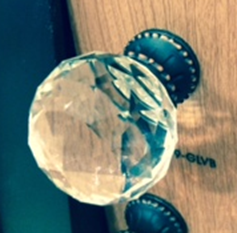

Very popular these days, glass and ceramic knobs can be a relatively inexpensive way to add a bit of sparkle or elegance to any style of kitchen. Vintage-style glass, also referred to as Depression Era glass, can provide a historical feel to a kitchen. Glass or ceramic knobs work well with vintage, eclectic, contemporary, traditional and country styles. One thing to keep in mind is that some of the more intricate styles can be a challenge to keep clean.
NOVELTY KNOBS
Novelty knobs are often called “artsy knobs” because they usually depict a theme, such as a motif of a “knife and fork”. It is a way of adding a bit of whimsy to any kitchen. If you want to make a personality statement of your own this is a perfect way to accomplish that. Just do not overdo it. A touch of artistry on one or two doors or drawers is sometimes better than an all-consuming look on every cabinet.
Before you get carried away on a really unusual design you need to ensure the grip is something you can manage. The last thing you want to do is add something to your cupboards that makes it a grip challenge. These kinds of knobs are well suited for modern, contemporary and traditional kitchens.
One thing to keep in mind – should you tire of the novelty knobs, sometimes it can be a challenge to find something that will cover up the holes that have been created. You may have to buy a knob or pull with a back plate.
KNOBS WITH BACK PLATES
Back plates are a great way to protect the cabinet from fingernail scratches and they are also a great way to cover up old holes if you are switching from knobs to pulls.
Keep plates as simple as you can because ornate back plates can be as difficult to clean as ornate knobs. Works with numerous styles: Mediterranean, Tuscan, Victorian, Asian, Traditional, Eclectic and Vintage.
PULLS
Basically, there are five popular types of pulls: Handle Pulls, Bar Pulls, Cup Pulls, Drop Handle Pulls (also called Bail Pulls) and Finger Pulls.
HANDLE PULLS feature handles that are secured to the cabinet at both ends.
These type of pulls are a great choice for flat-panel or shaker style cabinets. Shaker-style cabinets are those that are very simple but attractive. The panel doors are recessed and usually have natural finishes or light stains. Sometimes you will see that they have been painted to give a distressed, weathered look.
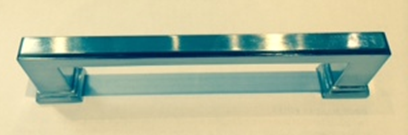

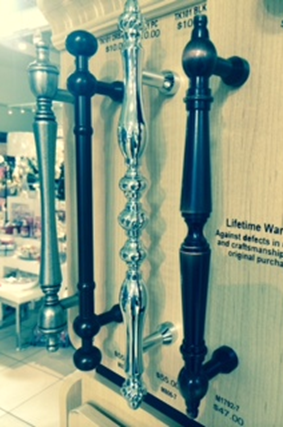 BAR PULLS are similar to handle pulls but they are not secured at the end. They are suspended by supports under the midsection of the pull.
Sturdy, beautiful bar pulls can eliminate the need for two pulls on a wide drawer.
As a guideline, pulls should not exceed two-thirds or three-quarters of the width of a drawer. For drawers 30” and wider – 2 bar pulls are often used. To create a less busy, more consistent look, use the same length handles.
This hardware comes in a number of finishes – stainless steel, satin nickel, black, polished brass, etc.
Pulls are generally easier for the elderly to use because they can use their whole hand instead of just their fingertips.
Pulls work well with Modern, Minimalist, Contemporary, Traditional and Shaker styles cabinets.
CUP PULLS
 Cup pulls look like upside-down cups. They give an attractive, vintage feel to kitchens. Can be described as: easy-to-use and easy-to-clean.
You can combine cup-shaped pulls will small knobs for the doors. Cup pulls with matching knobs can create a very sophisticated, yet
traditional feel. They are good for you if your drawers are heavy because they are very strong. Styles they work with – Shaker*, Traditional, Vintage, Country, Eclectic.
DROP HANDLE PULLS (Bail Pulls)
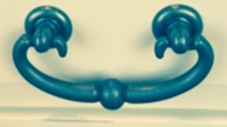 Drop pulls have two anchor plates with a pivoting handle suspended in-between. They give a furniture feel to cupboards. This can be somewhat of a deterrent to toddlers who are trying to open the cupboard door.
Drop handle pulls can work well on any cabinet style. Choose a modern design for modern cabinets and a traditional design for traditional cabinets.
FINGER PULLS
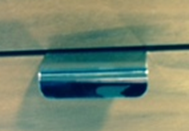 These tiny pulls offer a minimalist look for a modern kitchen. They are usually about one and a half inches in length and can be opened with one or two fingers. They are mounted on the backside of a drawer or cabinet door.
CREMONE BOLTS
If you are concerned about some treasures you have in a particular cabinet, you could install a Cremone bolt. This is not a hugely popular locking knob because the mechanism can be quite expensive but it is very effective in keeping your valuables safe.
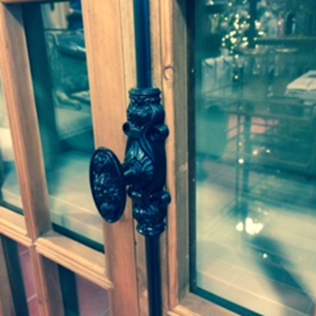 A Cremone bolt can be used on cupboard doors as a locking device.
A knob or handle is linked to a vertical rod that when turned can make the rod slide in and out of a socket at the top and bottom of the door to lock it or unlock it.
When I was researching this article one author described the variety of knobs and pulls available as “more choices than there are stars in the sky” and I think that underlines how difficult it can be to make the right choice.
If you find the hardware that you think is right for you, I suggest you buy one or two samples and take them home to try before buying hardware for your entire kitchen and always ask if the knobs or pulls carry a warranty.
To your success,
Linda Gardner
Pemberley Lane Design
905-466-6321
www.pemberleylanedesign.com
*Note – pictures of knobs and pulls courtesy of :
Emerald Kitchens & Design Inc., Burlington (Wayne Burgess, President)
Aroma Kitchens & Baths Inc., Oakville (Karen Kreplin, Designer)